The Definitive Guide to the Best Time for a Halmahera Liveaboard: November to April
The regulator’s hiss is the only sound that punctuates the deep, resonant blue. Below, a sloping reef wall disappears into an indigo abyss, every surface covered in a dense mix of life. A school of several hundred yellow-dashed fusiliers moves as one, a fluid silver-and-gold river parting around you. This is Halmahera. It is not a destination for the casual tourist; it is an expedition to the biological epicenter of the planet, a region where the Indian and Pacific Oceans converge in a spectacular display of marine biodiversity. For the serious diver, the question is not if one should explore this frontier, but precisely when.
Information on Indonesia’s North Maluku province is notoriously scarce, often fragmented and outdated. Planning an expedition of this caliber requires precision. Committing to a halmahera liveaboard is a significant investment in time and resources, and timing is the single most critical factor determining the quality of the experience. The central challenge for discerning divers is identifying the optimal operational window that aligns calm seas, exceptional visibility, and peak marine life activity. The answer lies within a specific six-month period: the dry season, from November through April.
Why November to April is the Apex Season for Halmahera Diving
The Indonesian archipelago is governed by two dominant monsoons. While many regions have their own microclimates, the Halmahera Sea and the waters surrounding Morotai experience their most favorable conditions during the Northwest Monsoon, which brings a period of relative dryness and calm from late autumn to early spring. This season is not merely about pleasant weather; it directly translates to superior underwater encounters. The shift in monsoon winds from November onwards dramatically reduces the sea-surface chop in the Halmahera Strait. That stability extends through the water column, minimising suspended sediment and producing the gin-clear visibility for which the region is revered. See also: see Halmahera Liveaboard’s About.
During these months, water conditions are consistently exceptional. Visibility frequently extends beyond 30 meters, and on exceptional days, can approach a crystalline 40 meters. Water temperatures are a comfortable 28-30°C (82-86°F), allowing for long, immersive dives with minimal thermal stress. More importantly, the predictable, gentler currents of this season open up access to exposed pinnacles and channel dives that are often inaccessible during the turbulent Southeast Monsoon (May-October). This is the time when pelagic species are most reliably sighted. Oceanic manta rays, grey reef sharks, and vast schools of dogtooth tuna patrol the deep-water channels, drawn in by the nutrient-rich, clear waters. A maluku liveaboard during this period is a calculated decision to witness the ecosystem at its most vibrant and accessible.
A Month-by-Month Analysis of the Halmahera Dry Season
While the entire November-to-April window is excellent, nuanced differences exist month by month. Selecting the right time for your halmahera diving expedition can be tailored to specific interests, from pelagic encounters to macro photography. Here is a tactical breakdown of the prime season.
- November – December: The Grand Opening. As the seas calm, this early phase of the dry season offers some of the year’s best visibility. It’s a superb time for wide-angle photography, capturing the dramatic underwater topography of sites like the volcanic pinnacles off Pulau Pisang. The water is nutrient-rich following the monsoon change, attracting large schools of fish.
- January – February: The Calm Heart. This is the zenith of the calm season. Sea conditions are typically at their flattest, making for smooth crossings to the more remote and exposed islands, including the northern coast of Morotai. This period is ideal for technical divers and those focused on the WWII wrecks, where calm surface conditions are a significant operational advantage.
- March – April: The Pelagic Peak. The water remains warm and largely clear, though a slight increase in plankton begins to occur. While this can fractionally reduce visibility from its January peak, it acts as a magnet for large filter feeders. This is arguably the best period for consistent manta ray sightings at cleaning stations, and the chances of encountering transient whale sharks increase.
| Period | Sea State | Average Visibility | Water Temperature | Key Marine Life Encounters |
|---|---|---|---|---|
| November – December | Calming, occasional chop | 30-40 meters | 28-29°C (82-84°F) | Vast schools of fusiliers, barracuda; excellent for wide-angle photography. |
| January – February | Typically flat calm | 25-35 meters | 28-30°C (82-86°F) | Ideal for wreck penetration (Morotai), reef sharks, exploring exposed atolls. |
| March – April | Calm with light breezes | 20-30 meters | 29-30°C (84-86°F) | Oceanic manta rays at cleaning stations, schooling hammerheads (rare), potential whale sharks. |
Halmahera Strait: Phinisi vs. Motoryacht Expeditions
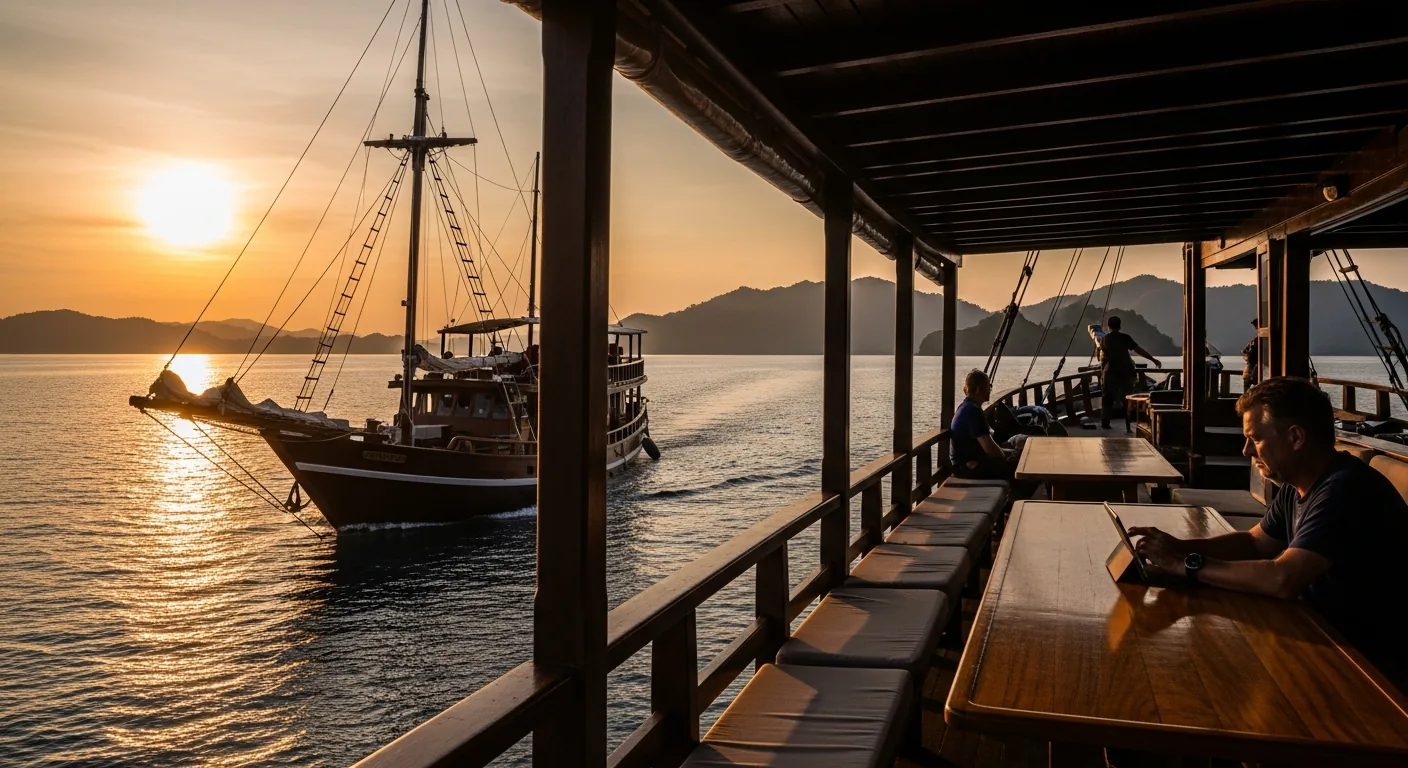
The vessel you choose is as critical as the season. Your platform for discovery dictates the expedition’s pace, range, and character. In Halmahera, two primary options exist: the traditional Indonesian Phinisi and the modern Motoryacht. A halmahera phinisi, a handcrafted two-masted sailing schooner, offers an authentic and stable experience. Vessels like the MV Juara Laut are built from ironwood and teak, their broad beams providing exceptional stability both under sail and at anchor. With a typical cruising speed of 8-10 knots and a guest capacity of 12-16, the phinisi fosters an intimate, classic maritime atmosphere, perfectly suited for sheltered passages between Halmahera’s myriad islands.
In contrast, a motoryacht such as the MY Garuda Explorer provides speed, range, and contemporary comfort. With cruising speeds of 12-15 knots, these vessels can cover greater distances more efficiently. This is a distinct advantage for itineraries that include the open-water crossing to Morotai or aim to connect disparate dive regions within a single expedition. The choice is a matter of personal preference, weighing the romance and tradition of a phinisi against the efficiency and expanded range of a motoryacht.
| Feature | Traditional Phinisi (e.g., MV Juara Laut) | Modern Motoryacht (e.g., MY Garuda Explorer) |
|---|---|---|
| Cruising Speed | 8-10 knots | 12-15 knots |
| Ambiance | Classic, romantic, stable, intimate | Efficient, modern, spacious, longer range |
| Itinerary Focus | In-depth exploration of core Halmahera sites | Extended range, including Morotai and remote atolls |
| Indicative Cost per Night | USD 550 – 700 per person | USD 650 – 850 per person |
Morotai Liveaboard: Diving into the Pacific War’s Silent Legacy
No discussion of Halmahera is complete without addressing the historical significance of Morotai. For those with an interest in military history, a morotai liveaboard offers a unique and somber diving experience. In 1944, this small island became a critical Allied forward base under General Douglas MacArthur, a staging point for the liberation of the Philippines. The waters surrounding Morotai are a submerged museum of the Pacific War.
Diving here is a different discipline. The focus shifts from pristine reefs to the silent, coral-encrusted relics of conflict. One of the premier sites is a Bristol Beaufighter, a twin-engine fighter-bomber resting upright on a sandy bottom at 35 meters. Its cockpit is still largely intact, a poignant reminder of its final mission. Elsewhere, the remains of a Japanese freighter, the Kinugawa Maru, lie in shallower water, its hull now a thriving artificial reef. According to David Llewellyn, a maritime historian and author of Wrecks of the Spice Islands, “The wrecks of Morotai are significant because they are largely untouched by commercial salvage. They represent a preserved moment in time, offering divers a direct connection to the events of 1944-45.” These dives require advanced certification and a respect for the sites as historical artifacts and war graves.
Signature Dive Sites of the Halmahera Dry Season
The sheer number of potential dive sites in the region is staggering, with new locations still being charted. During the November to April season, a Halmahera Liveaboard expedition provides access to the archipelago’s most celebrated underwater locations. See also: explore Halmahera Dive Sites.
- The Passage: A legendary channel separating Halmahera and Bacan, this site is a high-velocity drift dive. The current, when running, propels divers along a wall adorned with enormous black coral bushes and gorgonian sea fans measuring several meters across. The water is thick with fusiliers, surgeonfish, and patrolling grey reef sharks. A dive for experienced divers only, typically profiled between 15 and 30 meters.
- Pulau Pisang’s Pinnacles: A cluster of submerged volcanic sea mounts that rise from the deep. These structures act as magnets for marine life, attracting immense, spiraling schools of chevron barracuda and bigeye trevally. The pinnacles are also a macro photographer’s haven, with pygmy seahorses (Hippocampus bargibanti) camouflaged on Muricella gorgonians.
- Morotai’s Mitita Shark Point: An exposed point on the island of Mitita, just off Morotai’s coast, known for its reliable shark encounters. The confluence of currents attracts dozens of blacktip and whitetip reef sharks. In the blue, it’s not uncommon to see larger grey reef sharks and the occasional scalloped hammerhead. A reef hook is essential equipment for this dive.
- Weda Bay’s Critter Sanctuaries: Demonstrating the region’s incredible biodiversity, the black-sand bays of Weda offer a world-class muck diving experience. Here, the focus shifts from the pelagic to the peculiar. The substrate is home to flamboyant cuttlefish, mimic octopus, wonderpus, and a host of rare nudibranch species, providing a perfect counterpoint to the high-energy reef dives.
Planning Your Halmahera Maluku Liveaboard: Logistics and Investment
An expedition to this remote corner of Indonesia requires careful logistical planning. The primary gateway to the region is Ternate’s Sultan Babullah Airport (TTE). Direct flights are available from major Indonesian hubs like Jakarta (CGK) and Manado (MDC) on carriers such as Garuda Indonesia and Lion Air. Most liveaboard itineraries begin and end in Ternate, where you will be met and transferred to the vessel. See also: Contact pricing.
A comprehensive maluku liveaboard typically spans 8 to 11 nights to do justice to the area’s scale. The investment for an 11-night expedition aboard a premium phinisi such as the Juara Laut ranges from USD 6,000 to USD 8,500 per person. This rate is generally inclusive of all dives, full board, tanks, weights, and transfers from Ternate airport. Exclusions typically include marine park fees (approximately USD 150-200), equipment rental, nitrox, and crew gratuities.
Your packing list should reflect the serious nature of the diving. A 3mm or 5mm full-length wetsuit is recommended. Essential safety equipment includes a surface marker buoy (SMB), a dive computer, and a reef hook for high-current sites. Given the remoteness, carrying personal spares and any specialized photographic equipment is strongly advised. See also: Home pricing.
Your Pre-Expedition Checklist:
- Confirm your dive certification is Advanced Open Water or higher, with a logbook showing at least 50 dives, including experience in currents.
- Secure comprehensive travel and diving insurance. We recommend policies from Divers Alert Network (DAN) or an equivalent provider.
- Consult with our expedition specialists to align your travel dates with your specific interests, whether it’s wreck exploration in February or manta encounters in April.
- Book your international and domestic flights to Ternate (TTE) well in advance, ideally 90 days or more, to secure the best routes and pricing.
Secure Your Place in the Apex Season
The November to April window offers a rare opportunity to explore one of the world’s last great diving frontiers in optimal conditions. The combination of calm seas, clear water, and prolific marine life makes this the definitive season for a Halmahera expedition. Availability on the best vessels is limited and secures far in advance.
To begin planning your expedition to the Spice Islands, contact a Halmahera Liveaboard specialist. We provide expert, firsthand advice to ensure your voyage is calibrated to your experience level and diving ambitions.
Halmahera Liveaboard
Phone: +62 811-3823-875
Email: [email protected]
Office: Jalan Sunset Road No. 88, Kuta, Badung, Bali 80361, Indonesia